


Tabor Genesis 1.1 – 4.23 detail
A Torah scroll is the most sacred ritual object in Judaism. It consists of the Five Books of Moses — Genesis, Exodus, Leviticus, Numbers, and Deuteronomy — hand lettered in Hebrew on parchment made from the skin of a kosher animal, often a calf.
The parchment panels are sewn together to make a long scroll. The Five Books, also known as the Pentateuch, constitute the beginning of the Hebrew Bible, the Old Testament.
It takes over a year for a sofer, a skilled scribe, to produce a Torah. The text — 304,805 characters — is always lettered in black ink, without vowels, punctuation, or musical tropes. Reading or chanting from the Torah is a central part of services on Shabbat and holidays.
When the Nazis swept through Europe in their relentless efforts to exterminate the Jewish people before and during World War II, they made a point of capturing many Torahs, with an eye to eventually holding them for ransom. At the end of the war, over 1500 of these Holocaust Torahs were obtained from the Czech government by the Memorial Scrolls Trust, an independent charity in London. Many of these are now on permanent loan to congregations around the world.
Our synagogue, Congregation Beth El in Berkeley, has two of them. Recently it was my honor to recapture them — photographically — in their entirety. The photos are intended to serve two purposes.
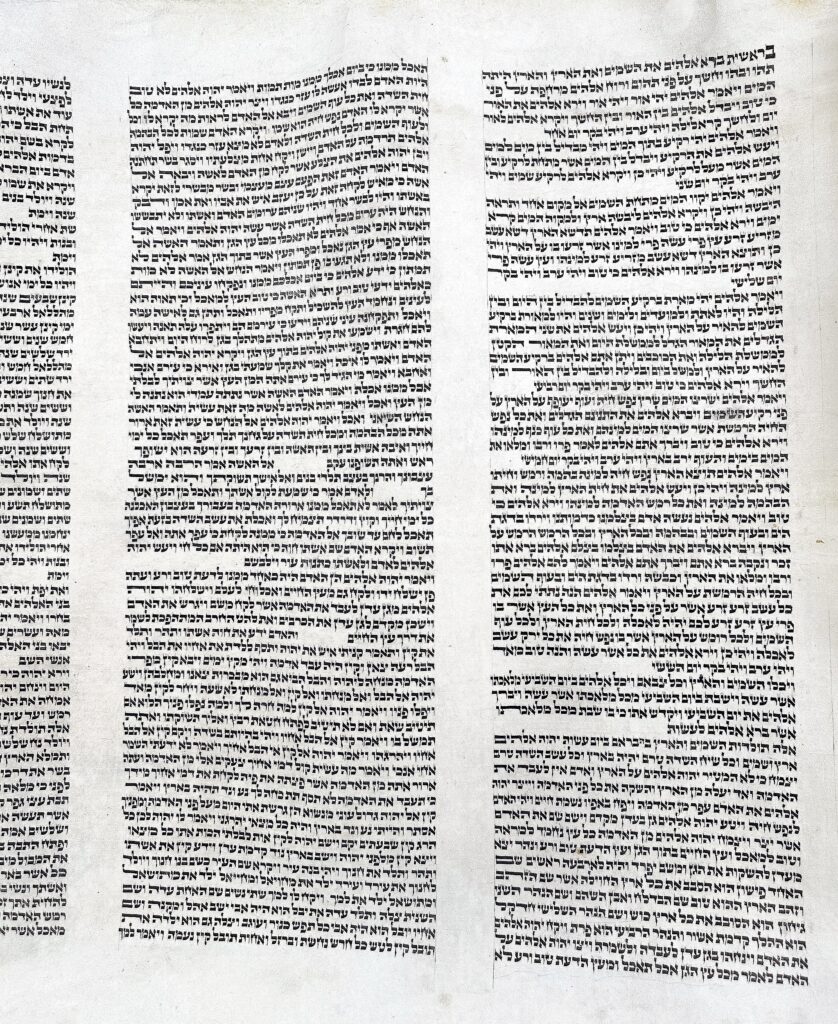
Tabor Genesis 1.1 – 4.23
First, they provide a record, panel by panel, of the physical condition of the Torahs, helping to determine which parts might need repair.
Second, they can be used as a guide for clergy and lay people to study and rehearse for chanting from the Torah at upcoming services. There is now a standard layout for Torahs, a designated number of characters per line, lines per column, columns per panel. But the Holocaust Torahs at our synagogue are each over 200 years old, and they don’t follow the standard pattern.
It’s difficult enough to chant Biblical Hebrew without vowels, punctuation, or the trope symbols that signify various melodic phrases. Dealing with a non-standard layout is a bit easier when the reader can study in advance a photo of the passage as it appears in the Scroll they will use while chanting. Of course, numerous books exist that include vowels, punctuation, and tropes, but they are rarely used during services. Because finger oils are thought to be damaging to the parchment, readers usually use a special pointer called a yad, which is often shaped like a hand.
The two Holocaust Torahs are known as Tabor and Kladno, named for the Czech towns where they were originally captured. In two sessions months apart, I was able to photograph them all, panel by panel.
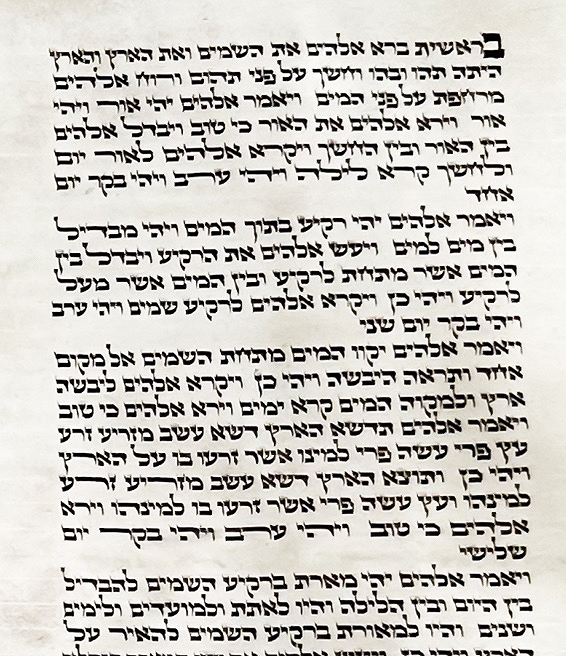
Kladno Genesis 1.1 – 5.30 detail
Two colleagues wearing gloves unrolled each Torah on a long table. I borrowed two professional softlights from my friends at Clean Slate Video, which I placed at 45-degree angles to the surface of the scroll, a standard setup for photographing flat artwork.
I had brought along my Canon DSLR camera, but after some tests, I opted to shoot the project with my iPhone. The field of view was perfect for the panel sizes. Since there was no budget for equipment rentals, I served as an impromptu “Armstrong” animation stand, poised at my full height about two steps up on the Bema (the raised platform at the front of the synagogue sanctuary), bending over, looking down on the scroll. I was very glad that the iPhone was much lighter to handhold and manipulate than the Canon.
It took 55 separate shots to capture all the text in Tabor. 61 lines per column.
The columns in Kladno had 54 lines each, but they were narrower. We were able to record Kladno in 44 shots. For both Torahs, the photos looked clear and sharp. In the following weeks, one of my colleagues painstakingly examined all the photo files and identified the starting and ending book, chapter, and verse shown on each. We renamed each file to reflect the chapter and verse within.
At the same time, using Adobe Lightroom to process the photos digitally, I tried enhancing the contrast a bit to increase readability. I found that if I added too much contrast, some of the fine detail (i.e., thin lines on certain letters) was lost. Because of this delicate balance, I didn’t add much contrast after all, though I did apply some electronic sharpening, to good effect.
When we shot the photos, despite our best gentle efforts to flatten out each scroll, we couldn’t push that too far, for fear of damaging the parchment. As a result, many of the pages have curved lines of text. But it’s all in sharp focus and quite readable (if you read Hebrew, of course). And when you zoom in on any photo, either on a phone or computer, you can easily fill the screen with one column width.
Check out the photos to compare the look of Tabor vs. Kladno, for the first few chapters of Genesis. Here you can also clearly see the curved distortion resulting from our inability to flatten the parchments. Many thanks to Judy Tate, Yonatan Frisch, and Lisa Feldman for their assistance in handling the Torahs during our shoots, and to Judy for her weeks of work, figuring out which Torah text appears on each panel.

Kladno Genesis 1.1 – 5.30
More about Holocaust Torahs:
https://www.memorialscrollstrust.org
https://www.nytimes.com/2024/02/05/arts/torah-scrolls-survived-the-nazis.html
https://www.amazon.com/Am-Holocaust-Torah-Saving-Torahs/dp/9652292362


